
Amrit Nivesh | ARN 113567 | AMFI-registered Mutual Fund Distributor
Since 1 April 2026, income tax in India has worked under a new law, the Income-tax Act, 2025. The 1961 Act still governs the years before that. The new Act calls the April to March year a “tax year”, and it has moved the familiar rules to new section numbers, so the old 80C is now section 123. This is how it treats money you have in mutual funds.
When tax comes up
There are two moments. The first is when you redeem units. Switching to another scheme counts too, because your units in one scheme are redeemed to buy units in the other, even though no money reaches your bank. The second is when a fund pays you an IDCW, the payout that used to be called a dividend.
While you simply hold your units, nothing is taxed, however far the NAV rises or falls. When you do redeem, the tax on your gain depends on two things: what kind of fund it is, and how long you held the units.
Equity funds
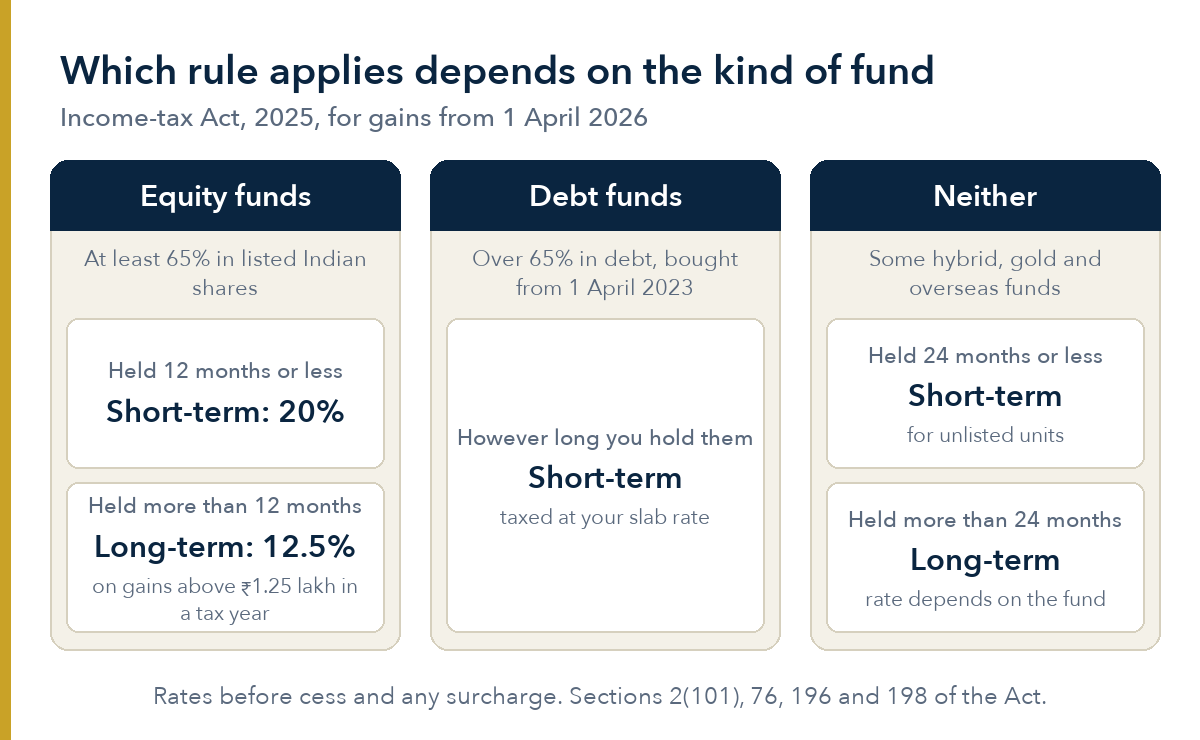
For tax purposes, an equity fund is one that keeps at least 65% of its money in shares of Indian companies listed on a stock exchange. That test is in section 198 of the Act.
If you held the units for 12 months or less, the gain is short-term and is taxed at 20% under section 196. If you held them for more than 12 months, the gain is long-term. Your long-term gains from equity funds and listed shares are added together for the tax year, and the first ₹1.25 lakh of that total is not taxed. The rest is taxed at 12.5% under section 198.
An example with made-up numbers. Say your long-term gains from equity funds in one tax year come to ₹2,00,000. The first ₹1,25,000 is not taxed. The remaining ₹75,000 is taxed at 12.5%, which comes to ₹9,375 before cess.
Debt funds
The Act’s name for a debt fund is a Specified Mutual Fund: one that puts more than 65% of its money into debt and money market instruments, such as bonds and treasury bills. Under section 76, units of such a fund bought on or after 1 April 2023 are treated as short-term however long you keep them. The gain is added to the rest of your income and taxed at your slab rate, the way interest from a fixed deposit is.
Debt fund units bought before 1 April 2023 follow older rules. If you still hold some, ask before you redeem them.
Funds that are neither
Some funds pass neither test. Some hybrid funds fall in between, and so do gold funds and funds that buy shares abroad. For these, units that are not listed on a stock exchange count as long-term only after 24 months, under the definitions in section 2 of the Act, and the rate depends on the fund. These are the ones most worth a question before you sell.
If you invest through a SIP
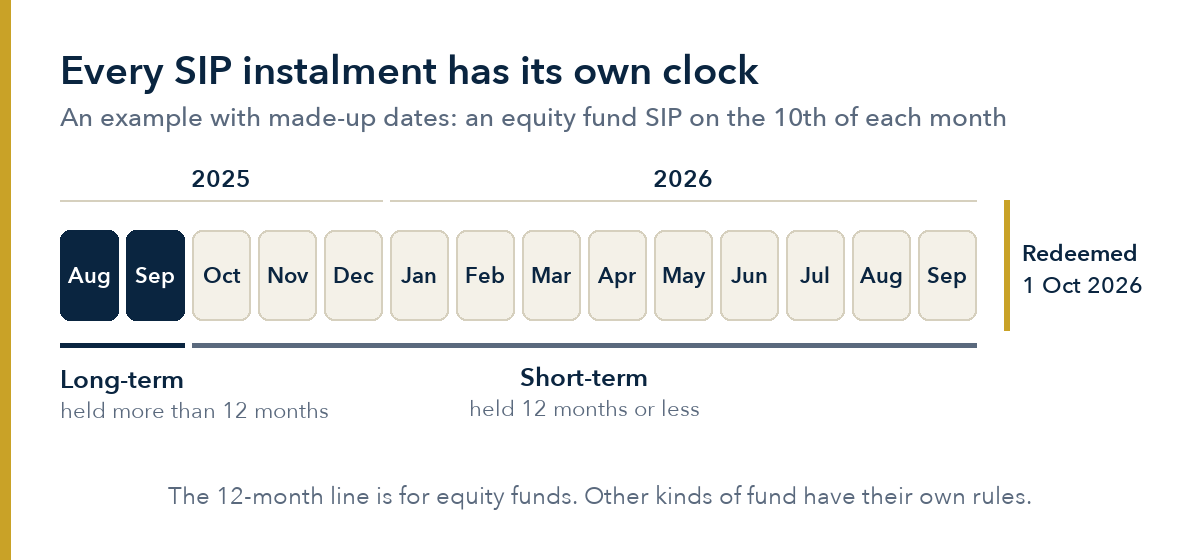
Each SIP instalment buys its own units on its own date, so each one has its own holding period. Say you have paid into an equity fund SIP on the 10th of every month since August 2025, and you redeem all of it on 1 October 2026. The August and September 2025 instalments have been held for more than 12 months, so their gains are long-term. The twelve instalments from October 2025 onwards give short-term gains, even though the SIP as a whole has run for more than a year.
The capital gains statement for your folio lists every lot with its purchase date, so you do not have to work this out by hand.
IDCW payouts
An IDCW is not a capital gain. It counts as income in the year you receive it, under “income from other sources” in section 92, and is taxed at your slab rate along with your salary, interest and anything else you earn.
Tax-saving funds (ELSS)
An Equity Linked Savings Scheme, or ELSS, is an equity fund. Money you put into one counts towards the deduction in section 123, the old 80C. The limit is ₹1.5 lakh in a tax year, shared with everything else listed in Schedule XV of the Act, life insurance premiums and provident fund contributions among them.
Two conditions come with it. The deduction is only available in the old tax regime. The new regime, which applies unless you opt out, does not allow it (section 202). And according to SEBI’s investor site, the money is locked in for three years. With a SIP, that means three years from each instalment. When you redeem later, the gain is taxed like any other equity fund’s.
The old section numbers and the new
- 80C, the deduction ELSS counts towards, is now section 123
- 115BAC, the new tax regime, is now section 202
- 111A, short-term gains on equity, is now section 196
- 112A, long-term gains on equity, is now section 198
- 50AA, debt fund units bought from April 2023, is now section 76
Before you redeem
The rates here are before cess and any surcharge. What you actually pay depends on the rest of your income, the regime you are in, and the dates on each lot of units, so your CA has the last word on your own filing.
If you hold funds through me and would like your capital gains statement, or want to know which of your units have crossed the 12-month mark before you redeem, send me a message and I will call you back.