
Amrit Nivesh | ARN 113567 | AMFI-registered Mutual Fund Distributor
A SIP, or Systematic Investment Plan, is a way of putting money into a mutual fund a little at a time. Instead of investing one large sum, you choose an amount and a date, and that amount goes from your bank account into the fund every month. Some people choose every quarter instead.
It is not a separate product. A SIP is simply a way of buying units of a mutual fund scheme, the same units someone investing a lump sum would buy.
How it works
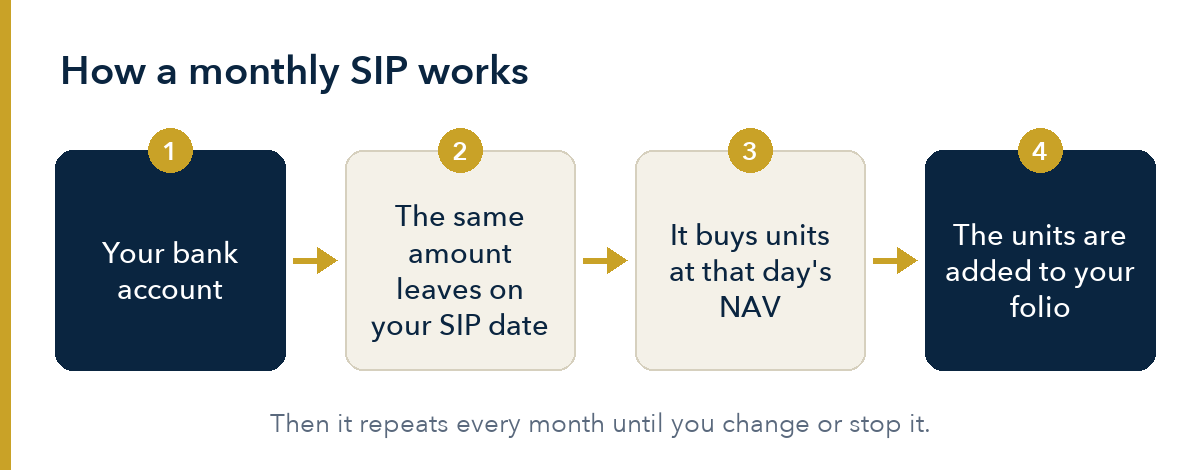
Every mutual fund has a price per unit, called its NAV (net asset value). It is worked out at the end of each business day and moves with the value of what the fund holds.
On your SIP date, your instalment buys as many units as it can at that day’s NAV. When the NAV is lower, the same amount buys more units. When it is higher, it buys fewer. Over many months, this evens out the price you pay for your units. You no longer have to decide when the market is “low enough” to invest, because you invest every month either way.
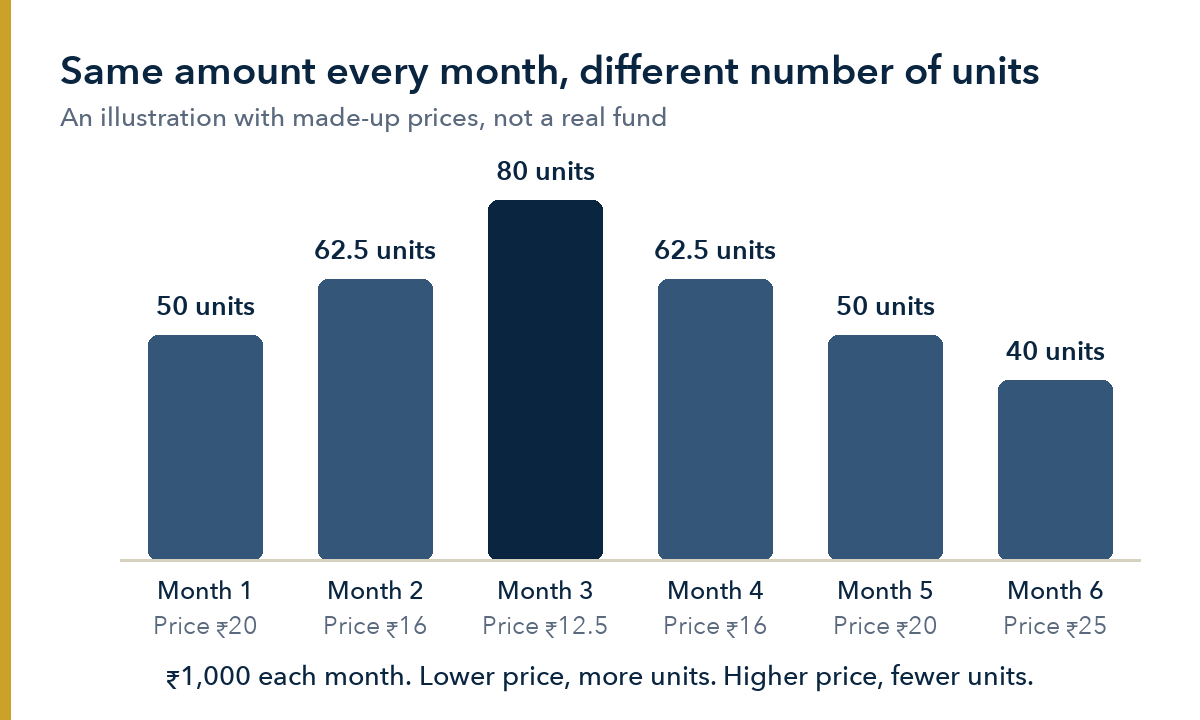
That averaging does not protect you from losses. If the market falls and stays down, the value of your units falls with it. What a SIP changes is how you invest, not how risky the fund is.
What you need to start
- KYC. A one-time identity check using your PAN and an address proof such as Aadhaar. Once done, it covers every fund house.
- A bank mandate. A standing instruction that lets the instalment be debited automatically on your chosen date.
- An amount. According to AMFI’s investor education site, an instalment could be as little as ₹500 a month. The minimum varies by scheme.
You can increase, pause or stop a SIP later. Stopping it does not sell the units you already hold; they stay invested until you choose to redeem them. Some schemes charge an exit load if you redeem within a set period, and tax-saving schemes lock in each instalment for three years, so check the scheme documents before you start.
How long to keep it going
A SIP is built for steady, regular investing over years, not months. Equity funds in particular can rise and fall sharply in the short run. People usually match them with goals that are several years away, such as a child’s education or retirement, and keep the SIP running through the ups and downs rather than stopping when the market falls.
What a SIP can’t do
- It cannot promise a return. The value of your investment depends on how the fund’s holdings perform.
- It cannot make an unsuitable scheme suitable. The choice of fund still matters, and depends on your goal, your timeline and how much ups and downs you can live with.
- It cannot replace an emergency fund. Money you may need at short notice is better kept somewhere you can reach it without selling at a bad time.
See the numbers for yourself
Our SIP calculator shows what a monthly amount could grow to over a period you choose, at a rate of return you type in. Try a few different rates; no one knows the real figure in advance.
If you would like to talk through starting a SIP, the paperwork, or how to set one up, send me a message and I will call you back.